SDG 9 · Circular Bioeconomy · Project 2 · Field trials
Every garden a field trial
Experiment and share how to clean soil and grow more food.
We are building a free field planner that helps a community garden run a fair experiment. Map the ground, check the soil, and plant in an order that makes the results worth trusting.
Each garden asks its own question. Together, a network of gardens and farms can answer questions no single plot could.
We are committed to doing this transparently, and with evidence.
How the Planner Works
Four steps take a piece of ground from a sketch to a planting plan. Nobody needs a science background to follow them.
1. Map the land
Draw the edge of your site, or bring in a map from QGIS. Then mark where not to plant: soil over the lead limit, paths, and a wild margin around each fruit tree.
Seedlings that sow themselves in those margins become a local seed bank. Some may make hardier rootstock as the climate changes. The planner tells you how much ground is left to plant.
2. Check the soil
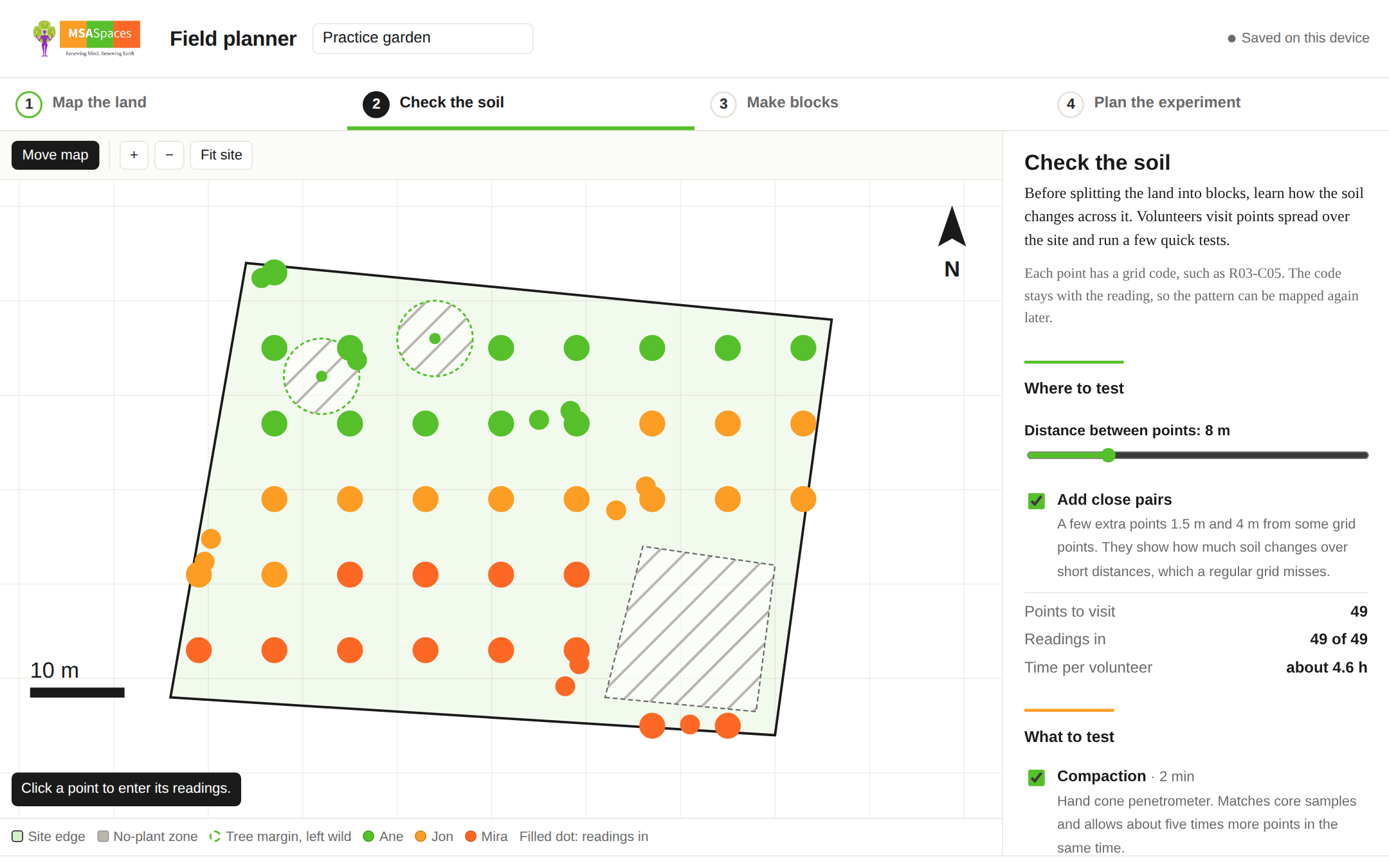
The planner spreads test points across the site and shares them out among volunteers. Each person gets one stretch of the walking route. At each point they run quick soil tests that anyone can learn.
Every point carries a grid code, such as R03-C05. Readings can then be mapped again next season, or years from now.
3. Make blocks
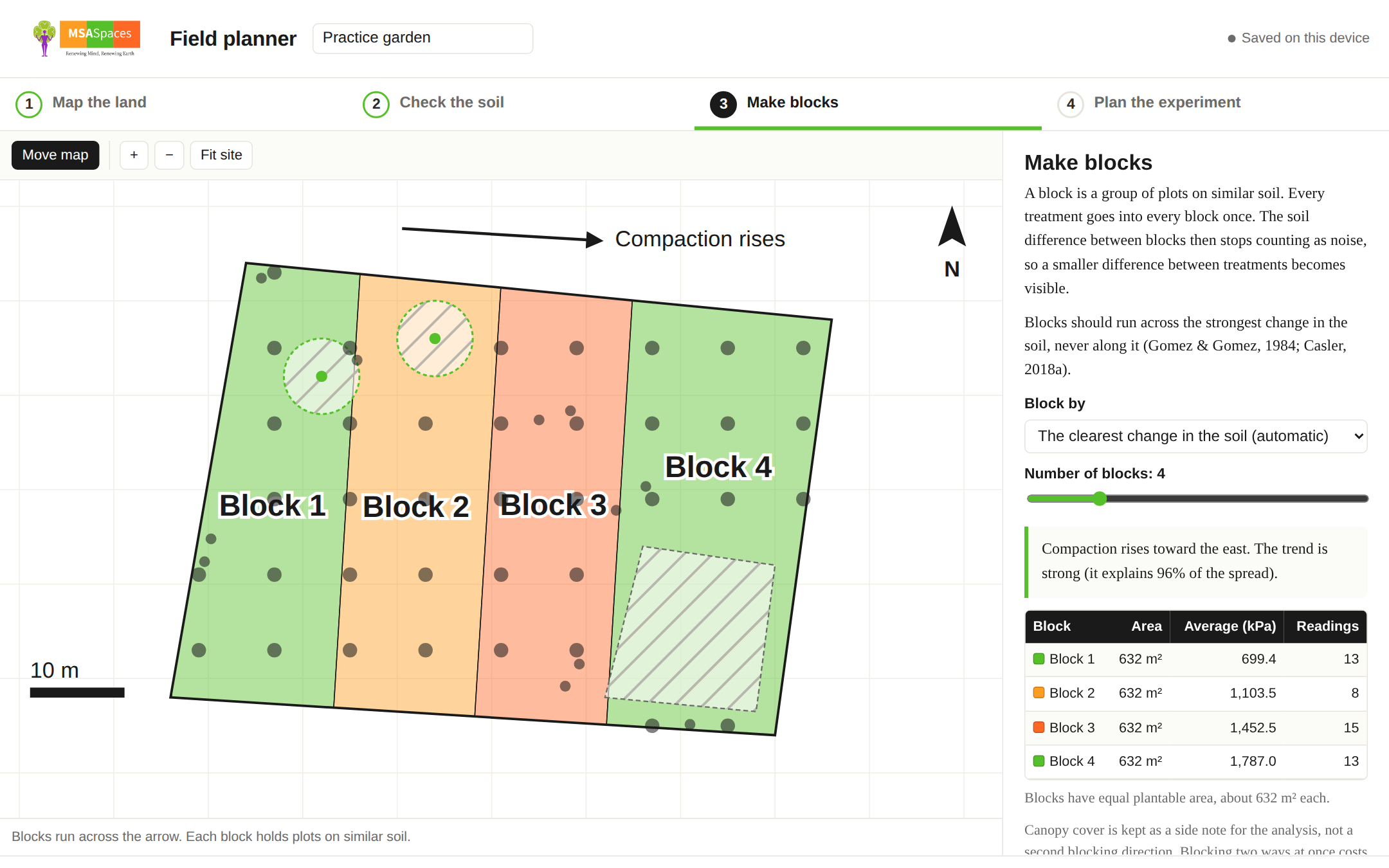
Soil is never the same from one end of a garden to the other. One corner drains well. One strip was packed hard by machines years ago.
The planner finds the clearest change in your readings and splits the land into blocks across it. Plots inside a block share similar soil. The soil then stops hiding the effect of what you plant.
4. Plan the experiment
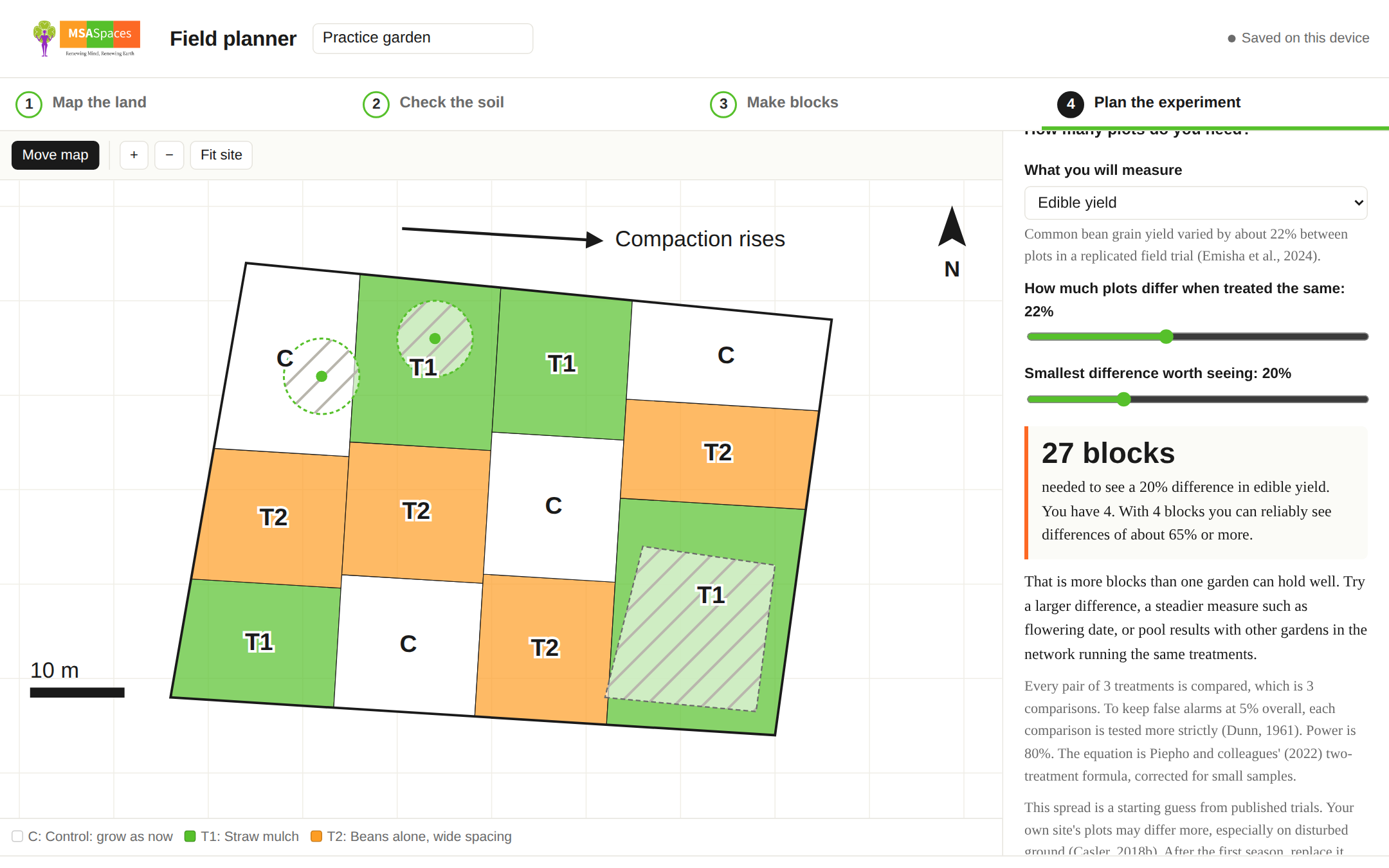
Start with a question. I wonder if straw mulch keeps beans growing through a dry July? The planner suggests treatments that suit your climate and soil.
It checks whether you have enough blocks to see a real difference. Then it shuffles the treatments inside each block, so no treatment gets the best spot by luck.
Mapping Urban Land: Where Food Is Safe to Grow
City soil can hold lead and other metals from old paint, leaded petrol, traffic and industry. You cannot see or smell it. So the first job on any urban site is a map: which ground is safe for food, which needs raised beds, and which needs cleaning first.
Volunteers take soil samples on a grid across the site, and a laboratory tests each one for lead. The map then fills in the ground between the sample points, so every part of the garden gets a colour. At our first site, at Lutxana in Bilbao, 20 sample points were enough to draw the map. The map splits the ground at 120 mg/kg of lead: nothing edible is planted in ground above it. That is stricter than Australia’s current level for home gardens, 300 mg/kg (see the note on these numbers below).
Safe to grow food
Food can grow in the ground. Maize and beans go on these clean blocks only. Every block is tested again each season, and a block that fails comes out of food growing.
Not for food in the ground
Food grows only in raised beds of clean soil over a barrier fabric. The ground itself grows plants and fungi that soak up and hold the metal, and they are never eaten. Where readings are highest, the ground is cleaned first and kept covered with woodchips or mulch, away from children’s play.
Never for food
Paths, the strip along the road, and the ground under the eaves of old painted buildings, where lead dust and paint flakes settle.
Biomass and Bioaccumulation: Where the Metal Goes
Plants take up a little metal from the soil through their roots. Bioaccumulation is how much builds up inside the plant compared with the soil around it. In most food crops it stays mainly in the roots. Less reaches the stems and leaves, and least reaches fruit and seed. That is why fruiting crops such as beans, maize, tomatoes and squash are the safer choice, and leafy greens and root crops, which grow in or close to the soil, need the cleanest ground.
Biomass is the amount of plant grown. For food, we want plenty of harvest with as little metal as possible in the part we eat. For cleaning soil, we want the opposite: plants and fungi that grow fast and hold metal in the parts we can cut and take away. Lead is hard for plants to take up, so cleaning is slow, and every harvest from those blocks is treated as waste.
Healthy, Organic and Safe to Eat
Organic means grown without synthetic pesticides or fertilisers. It does not mean free of metals: lead in the ground stays there whatever the growing method, and compost made from city green waste can carry some too. So for food that is healthy and safe to eat, we ask four things.
- Clean ground. Food grows only in the green zone or in raised beds filled with soil that has been tested clean.
- Clean harvest. Each season a sample of what we grow goes to a laboratory and is checked against the legal limits for lead in food: those set by Food Standards Australia New Zealand (FSANZ) here, and by the European Union at our Bilbao site. These limits are reviewed from time to time, so we check the current ones each season, and we publish the results.
- Clean kitchen habits. Wash and peel what you pick, and leave soil outside: most lead reaches people as dust and soil, not through the food itself.
- A good diet. Enough calcium, iron and vitamin C means the body takes up less lead. This matters most for children, so fresh, varied food from the garden helps twice over.
A Closed Loop: Food Blocks Help Clean the Rest
Nothing is wasted. After the maize and bean harvest on the clean blocks, the stalks and leaves become the growing bed for king oyster mushrooms (Pleurotus eryngii). The spent mushroom substrate, full of living fungus, is then spread on the blocks being cleaned, where the fungus helps hold and take up lead. Each block is tested again, and when one tests clean it can come back into food growing. We are studying this loop at Lutxana.
How We Lower the Risk, Step by Step
- Test. Total lead first, then the share plants and people can actually take up (the bioavailable share). For people, the US EPA’s Method 1340 estimates how much a body could absorb if soil is swallowed.
- Protect people now. Raised beds, covered ground and clean hands, as above.
- Lock lead in place. Compost, a near-neutral soil (pH about 6.5 to 7) and phosphate can turn lead into forms that dissolve less. We check for arsenic first, because phosphate can free it (Karna et al., 2018).
- Draw out what moves. On the blocks being cleaned, plants such as Indian mustard and sunflower, and king oyster mushroom substrate, take up part of the mobile lead. We never use chelating chemicals such as EDTA, which can wash lead deeper or into water.
- Check and share. The same sample points are retested each season and the results published, including when a method does not work. The aim is a measured fall in the bioavailable lead, not a promise that all lead is gone.
Why a Fair Test Takes Planning
Two beds given exactly the same care will still grow differently. Some of that is just chance. Whatever we try only counts when it makes a bigger difference than chance alone would.
Usual careWith mulch
Three simple habits keep a test fair. Compare like with like: split the garden into blocks of similar ground, and try every option in each block. Let chance choose: draw lots for which bed gets which option, so no one gives a favourite the sunniest spot. Try it more than once: one good bed could be luck, but the same result in several blocks is worth trusting.
Sometimes the honest answer is that one garden is not enough. Suppose plots differ by about a fifth when treated the same, which is common for bean yield. Seeing a 20% change between three treatments then needs around 27 blocks. Most gardens hold four or five.
The planner says so plainly. It also shows the smallest change your garden can see with the blocks it has.
That is why this is a network. Ten gardens running the same simple comparison can see what one garden cannot. Every garden that reports back makes the numbers sharper for all the others.
Soil Checks Anyone Can Do
Each test in the planner uses low-cost kit, and each one has been checked against a laboratory method. Where a test has not been checked yet, the planner says so.
Tap a test to open its illustration and see the kit it needs.
CompactionChecked against a standard method
A hand penetrometer pushed slowly into the ground. Above about 2000 kPa, roots struggle to push through.
You need: a hand penetrometer, a probe with a pressure gauge.
TextureChecked against a standard method
The ribbon test. Squeeze moist soil between thumb and finger and measure the ribbon it makes. Citizen scientists using this test were checked against laboratory results.
You need: a little moist soil and a ruler.
Water-holding capacityChecked against a standard method
Soil in a funnel lined with a coffee filter, soaked, drained and weighed. It closely matched laboratory pressure cells, using under $200 of equipment.
You need: a funnel, a coffee filter, a jar, water and kitchen scales.
Crumb stabilityChecked against a standard method
The free SLAKES phone app photographs dry soil crumbs as they sit in water. Crumbs that hold together mean soil that holds water and air.
You need: a few dry soil crumbs, a shallow dish of water and a phone with the free SLAKES app.
Canopy coverChecked against a standard method
A phone photo pointed at the sky. It shows how much shade each plot gets from nearby trees.
You need: a phone camera, laid face-up on the plot.
Soil pHReadings flagged: not yet checked
Strips or a pocket meter. We flag these readings. Low-cost pH methods have not yet been checked to the same standard as the tests above.
You need: pH test strips or a pocket pH meter, a cup and clean water.
Where It Is Now
A working draft of the planner runs in the browser. It maps a site, shares soil checks among volunteers, draws blocks, and lays out a shuffled plot plan. The plan downloads as a table to print, or as a map to open in QGIS.
The part that works out how many blocks you need was checked, number for number, against the statistical analysis from our soil work at Lutxana, Bilbao.
The Bigger Idea
The planner is the first piece of a citizen science app. Around it, we are building a support network that links urban gardening initiatives with rural food growers.
Gardens and farms run simple, fair trials and share what they find. Pooled together, those results become evidence strong enough to shape new organic growing techniques.
The clearest findings then show where more specialised scientific studies are worth the time and money. Those are the studies that can make farming more sustainable and help build a bio-based economy, where what we grow also feeds materials, energy and new livelihoods.
Projects 1 and 3 complete the picture. Project 3’s sensors build a digital twin of each site: a live model of its soil and microclimate that shows which plantings hold through flood, frost and drought. Project 1 asks how growing together affects the health and safety of the people doing the growing. All three run on the same sites and share the same open data.
Gardens as social prescriptions, measuring how growing together renews mind and body.
Fair experiments to clean soil and grow more food, shared so the next site starts further ahead.
Site sensors build a live model of each plot, with every species logged on iNaturalist.
Help Us Improve the Vision
This is where your help makes the biggest difference.
- Share your results. The planner starts from numbers in published trials. Every season a garden or farm reports back, those numbers move closer to real growing conditions.
- Bring what you know. Growers know which seeds and methods work on their land. Tell us, and the planner can suggest them to others on similar soil and in a similar climate.
- Help us connect the garden and the lab. Test the same soil twice and the lab result shifts a little each time. When we changed how our lab scanner reads a soil sample, the repeat tests needed fell from 36 to 8. Good plans allow for both kinds of variation: plots that differ in the ground, and readings that differ in the lab. If you test soil, we would love your help.
- Be one of the first. The network’s shared results are empty so far. We did not fill them with made-up numbers. Your garden or farm could be the first to report.
Collaborate With Us ✌🏾🙏💪
You don’t have to be technically minded to help. The planner needs people who code, people who garden, and people who like a good question.
We publish under share-alike and copyleft licences. You are welcome to use these tools to start your own social enterprise. We hope you will help us build forward-thinking roles for community members.
Help Build the Planner
The planner’s code and its statistics engine are open source. Test it on your own site, tell us where it confuses you, or help translate it into another language.
Have Ground to Test?
A school plot, an allotment, a verge, a roof, or a piece of ground nobody has known what to do with since something was knocked down on it. If you can mark out a few plots and write down what happens, you can run a field trial. No funding or research background needed 😌 We will help you plan it.
Further reading